Second-Generation Kitchens for a 1990s Master-Planned Community
Westchase reached the age where kitchens get replaced rather than repaired. Hillsborough County approved the development in 1991, and the community filled in through the 1990s and 2000s across nearly thirty distinct village neighbourhoods on more than 2,000 acres in the county's north-west corner.
That timing matters. The original cabinetry in a great many Westchase homes is now twenty-five to thirty years old — well past the point where builder-grade boxes hold up, and firmly into a finish palette that reads as dated. Honey oak, bulkheads above the wall cabinets, and shelves where drawers should be are the recurring themes.
The houses themselves are generally in good order, which makes this a cabinet job rather than a remodel. Call us today at +1 813-767-7535 for kitchen cabinet renovation in Westchase.
Westchase is organised into distinct villages, each with its own character and amenity mix, and most are governed by a homeowners' association. Within any given village the floor plans repeat, which means the kitchens repeat too — and so do the things homeowners want changed about them.
Because the plans repeat across a village, it is often possible to be specific very early about what a kitchen can become. The design is still measured and drawn for your house. Call us today at +1 813-767-7535 for kitchen cabinet renovation in Westchase.
Finish is what most Westchase homeowners raise first. The mid-tone and honey oak that was standard when these homes were built is the single clearest marker of a 1990s kitchen, and changing it does more for how the room reads than any other single decision. A lighter painted finish, or a natural wood in a cooler tone, generally makes these kitchens feel substantially larger as well.
Function is the second theme, and it is nearly always about drawers and the corner. Original lower cabinets in homes of this era are usually fixed shelves behind doors, with a blind corner that swallows whatever goes into it. Deep drawers across the lower run and a proper corner mechanism address the two complaints we hear most, and neither requires changing the footprint of the kitchen.
The third is the bulkhead. Almost every original Westchase kitchen has one, and almost every one can lose it. What sits inside it decides how much work is involved, which is checked at the consultation rather than assumed — in some plans it is empty framing, in others it carries a duct run that has to be worked around.
It is also worth checking the condition of the cabinet interiors rather than judging by the doors, which is where most people start. Pull out a lower shelf and look at how much it has bowed under weight, and check the underside of the sink base for swelling. Those two spots tell you more about whether a Westchase kitchen needs replacing than anything visible from the front.
Before anything else, it is worth establishing whether your cabinets need replacing or refacing, because the answer is not obvious from the outside. Refacing puts new doors and a new veneer on the existing boxes, and it is a reasonable option when those boxes are genuinely sound. In homes of Westchase's age the boxes are frequently the part that has failed — particle board carcasses in a Florida kitchen tend to sag along the shelves and swell wherever water has reached them. Facing a failing box is money spent on a structure that is on its way out.
Assuming replacement, the decisions that shape a Westchase kitchen are finish, height and interior fit-out. Moving away from the original oak palette does more visually than anything else. Taking the wall cabinets to the ceiling does more practically. And specifying the interiors properly at the design stage — drawer banks, a corner mechanism, dividers where they are actually needed — is what separates a kitchen that is merely newer from one that is genuinely better to use.
It is also worth thinking about the island or breakfast bar as part of the same scheme rather than an afterthought. Many Westchase plans include one that was drawn to fill space rather than to be used, either too narrow to seat anyone comfortably or configured so the seating overlaps the working side. Reworking the cabinetry around it is usually possible without moving plumbing, which keeps it inside the scope of a cabinet project.
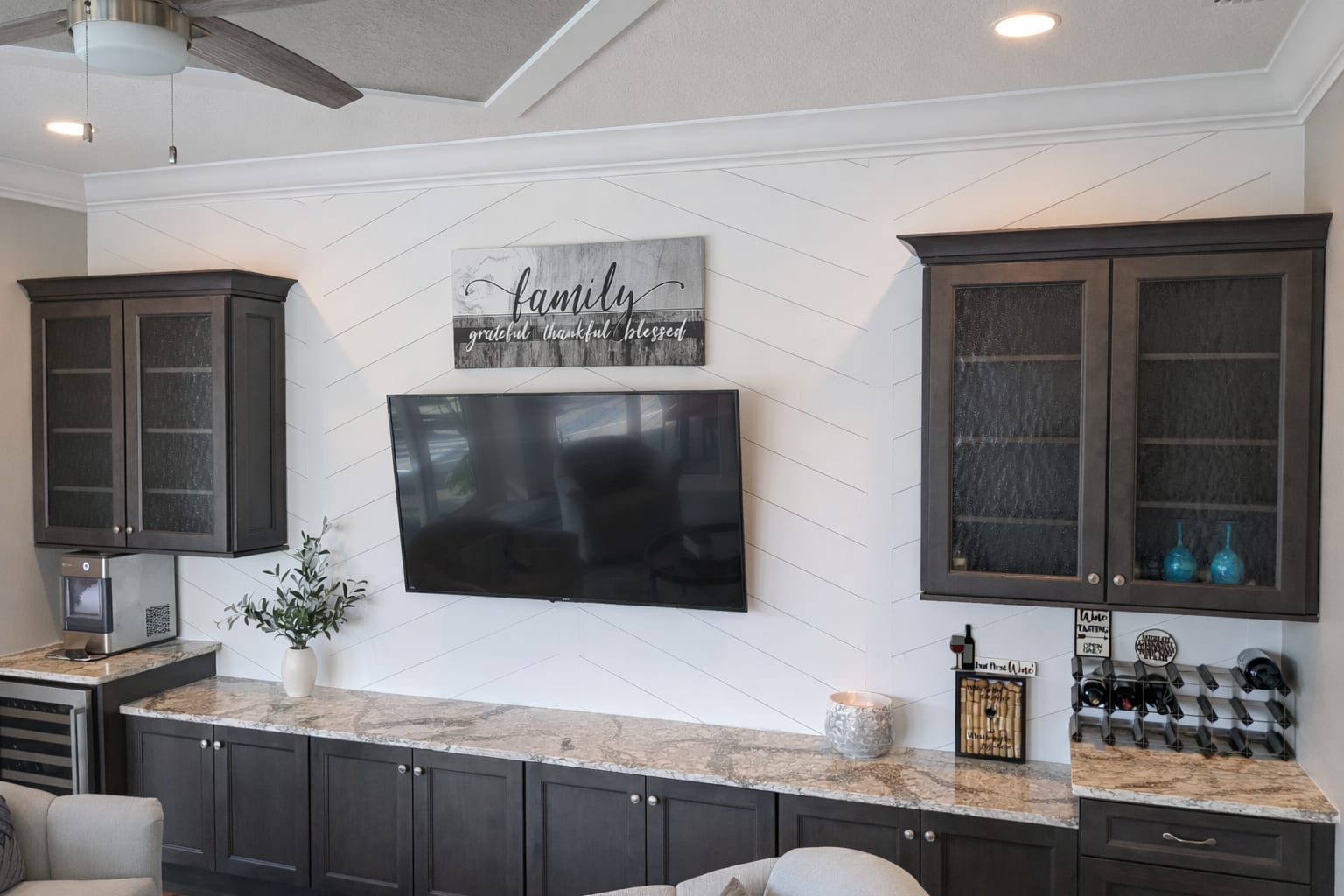
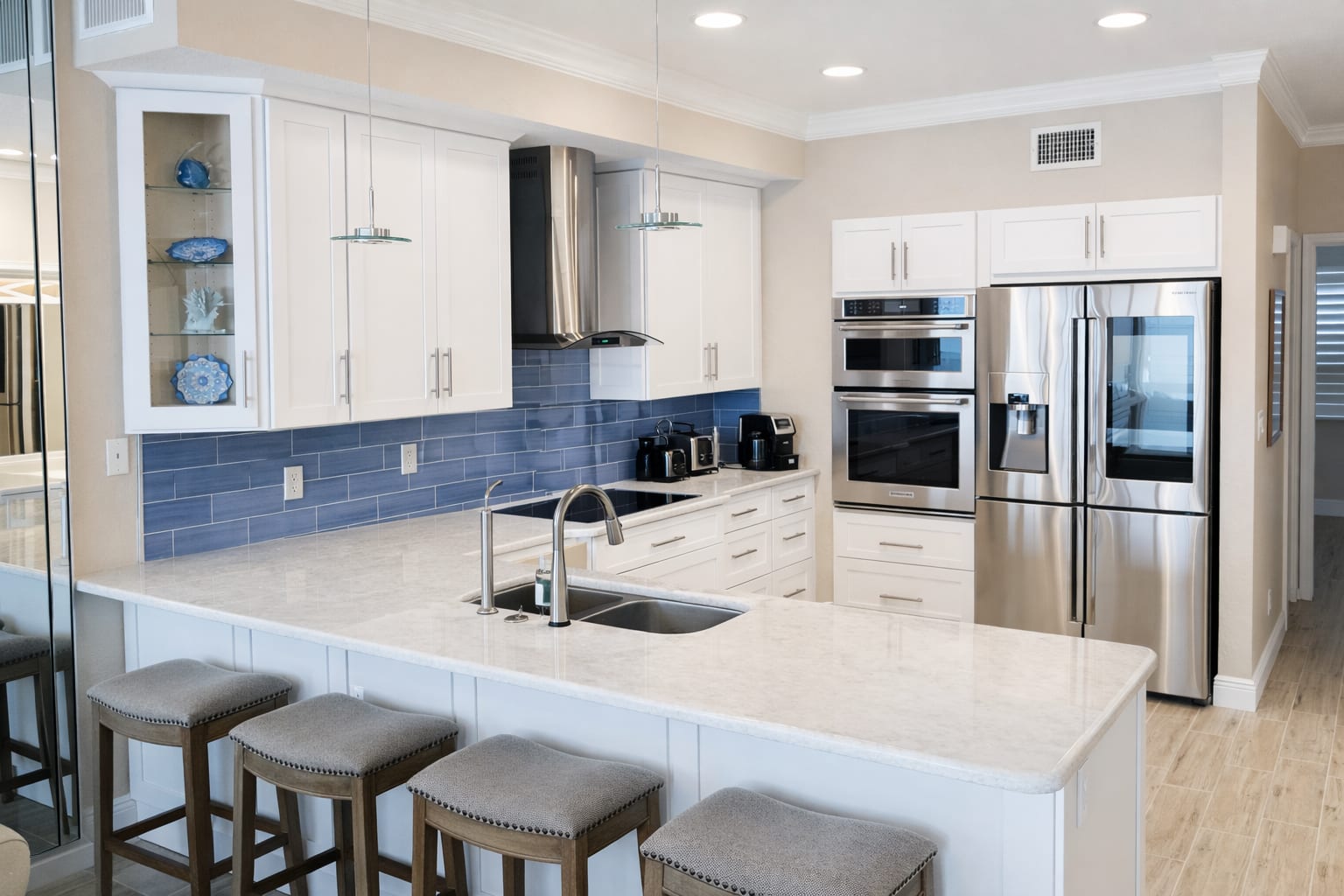
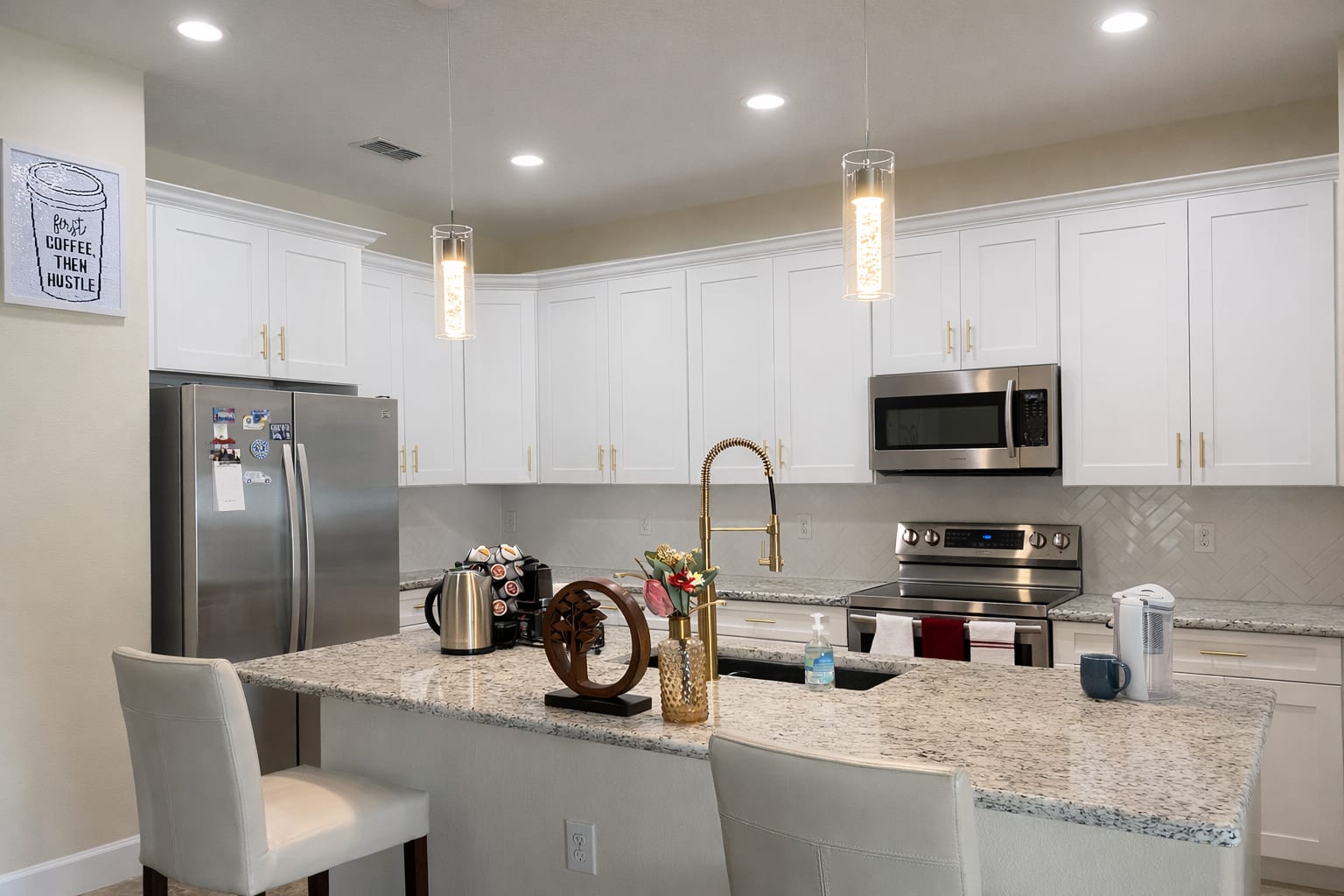
Kitchens designed, built and installed by Ryan Welker for customers across the Tampa Bay service area. See more completed projects.
Yes. Westchase is one of the fourteen Florida communities Trusted Choice Cabinets serves, along with Land O' Lakes, Lutz, Odessa, Tampa, Wesley Chapel, New Port Richey, Connerton, Trinity, Dade City, Brandon, Carrollwood, St. Petersburg and Clearwater. Call 813-767-7535 to set up a free in-home consultation.
Interior cabinetry does not normally fall under architectural review, because nothing visible from outside changes. Individual villages do differ, and some associations have rules on contractor parking, working hours or where a dumpster can sit. A quick check with your association before install week is scheduled avoids any friction.
Not necessarily, but it depends on the boxes rather than the doors. If the carcasses are particle board and have started to sag or swell — which is common at this age in Florida — then refacing puts a new front on a failing structure. If the boxes are genuinely sound, that is worth knowing too, and the consultation is where it gets assessed.
Sometimes, and it depends entirely on the condition of the boxes rather than the doors. If the carcasses are solid, refacing is a legitimate way to save money. In homes of this age with particle board boxes it usually is not, because you would be attaching new doors to a structure that is already failing. We will tell you which situation you are in at the consultation.
Most of the two-to-four week timeline is design approval and fabrication, which does not affect your kitchen at all. The disruptive stretch is the removal and install itself, typically a matter of days. You will get a realistic window once the design is approved.
A full kitchen typically runs two to four weeks from approved design to final install. That covers design approval, cabinet fabrication, removal of the old cabinets and installation. Approving the 3D rendering first shortens the timeline, because it removes revisions that would otherwise happen mid-build.
Yes. The design stage is a free in-home consultation and a ProKitchen 3D rendering that you approve before a single cabinet is ordered. Nothing gets ordered until you are happy with it.
All-wood construction with no particle board. Trusted Choice Cabinets partners with established cabinet manufacturers to offer a range of styles, finishes and price points.
Ryan Welker does it himself. The person on site already knows the drawing, because he is the one who made it, so nothing is handed off between a designer and an install crew.
A thirty-year-old master-planned home is often in better structural shape than its kitchen suggests. The roof, the windows and the layout are fine; it is the cabinetry that has aged, because it was the part built to a price when the house went up.
Replacing it with all-wood construction resets the clock on the room without the disruption or the cost of a full remodel. In most Westchase homes the appliances and plumbing stay exactly where they are, and the work is measured in weeks.
You approve a 3D rendering before anything is ordered, and Ryan Welker does the installation himself. Contact us today at +1 813-767-7535 for kitchen cabinet renovation in Westchase.
Coverage takes in Westchase and its village neighbourhoods across the north-west corner of Hillsborough County, along with neighbouring Town 'N' Country, Citrus Park and Odessa. Odessa is already part of the long-standing service area and sits directly north of Westchase, so this corner of the county is familiar ground rather than a new market.